Ama Ayurveda: Understanding Toxic Buildup and the Root of Digestive Imbalance

Understanding Agni Ayurveda and Digestive Fire
The idea of Ama Ayurveda offers a different way to understand why you can eat “healthy” and still feel heavy, foggy, or inflamed. In Ayurveda Ama theory, toxins are not just what you get from the outside. Most toxins are actually produced by your own body. “Ama” is the name for what’s left behind when digestion can’t fully process what you consume, creating buildup that may quietly influence everything from energy levels to elimination and immune resilience.
Ama Ayurveda: Internal Toxins, not External
In Ayurveda, symptoms rarely begin where they appear.
Bloating is not just bloating.
Fatigue is not just tiredness.
Inflammation is not random.
Often, the deeper cause is the production of food toxins (Ama). Ama is not a chemical toxin in the conventional sense, like BPA or PTFE/PFOA. It is a metabolic residue formed as the combined effect of food digestion, emotion, and experience that the body could not fully process—what you gave it as food. You might even say that “Ama” is the “rejection letter” your body sends you to let you know what you provided was not good enough.
Ayurveda Ama Theory: Resetting Old Patterns
There are three reactions that people go through with this rejection. One is to keep retrying the same thing over and over, receiving the same rejection. Two is to fix what you’re putting in so your chances of rejection are lower. This method does work for many. However, the third method is not only to change what you’re putting in, but also to “reset” the very thing that was rubber-stamping the rejections.
The thing is, after years of following the same eating pattern, your body retains a memory of what you provided. Then, even when you sometimes eat healthy, you still get the rejection stamp because the memory says, “You are in the habit of giving the wrong thing, so most likely what you’re giving now is also the same.” This is why quick diets don’t work either, as they never retrain the digestive system to learn the new food patterns. According to Ama Ayurveda protocol, in order for the body to actually stop producing Ama food toxins, one must change the inputs (foods we eat) and also retrain our digestive system to accept the new food patterns. The latter includes digestive support as well as detoxification, if required.
In Ayurveda Ama texts, the accumulation of food toxins is considered one of the primary contributors to imbalance and chronic disease. When digestive fire is compromised, residue accumulates. When metabolic residue and waste (toxins) accumulates, obstruction develops. And where there is obstruction, dysfunction follows.
Understanding Ama shifts the focus from symptom management to root-cause digestion support and management.
What Is Ama in Ayurveda?
Classical Ayurvedic texts describe Ama as:
Heavy
Sticky
Cold
Dull
Cloudy
Obstructive
Ama forms when digestive fire (Agni) is weak, irregular, or overloaded. Instead of being completely transformed into nourishment, food becomes partially processed material that lingers in the system.
Over time, these Ama toxins circulate through the body and may settle in vulnerable tissues.
Unlike modern detox culture, digestive toxins Ayurveda primarily refers to internal metabolic waste — not just environmental chemicals. This is an important distinction.
You can eat organic, high-quality food and still develop Ama if your digestive capacity is compromised.
The Root Cause: Weak Digestion
Ama does not form randomly.
It forms when transformation fails.
When digestion is weak:
Food remains in the gut longer than it should
Fermentation and gas increase
Nutrient absorption declines
Metabolic waste accumulates
This is why weak digestion Ayurveda treats as the precursor to many chronic complaints.
The body is designed to eliminate waste efficiently. Ama forms when digestive intelligence is overwhelmed or weakened — whether by overeating, incompatible food combinations, stress, irregular meal timing, or excessive cold/heavy inputs.
Before asking how to detox, Ayurveda asks: is digestion strong enough to prevent buildup in the first place? 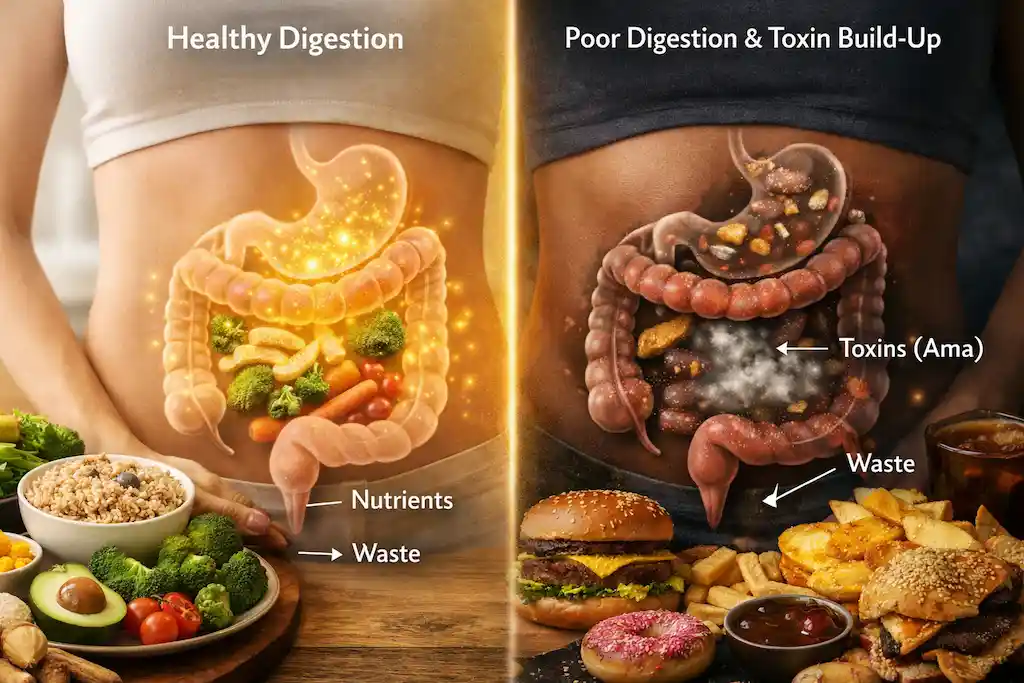
Signs of Ama: Early Indicators of Imbalance
Ayurveda identifies specific signs of Ama that appear before major disease develops. Usually, people seek “gut health” solutions at this stage, without realizing that many of the symptoms and conditions throughout the body are linked to the digestion and Ama production.
Common Ama symptoms include:
Coated tongue (especially thick or white coating)
Heaviness after eating
Sluggish energy
Brain fog
Bloating or gas
Bad breath
Joint stiffness
Low appetite
These are not random inconveniences. In ama ayurveda, they are early warning signals.
When recognized early, imbalance can often be corrected gently. When ignored, ama may travel deeper into tissues and contribute to inflammatory patterns.
How Ama Spreads Through the Body
Ama typically begins in the digestive tract. If not cleared, it can enter circulation and move through the body’s channels (srotas).
Where it settles depends on individual vulnerability.
In joints → stiffness and discomfort
In skin → rashes or dullness
In the respiratory system → congestion
In metabolism → weight stagnation
In immunity → hypersensitivity
This is why symptoms may appear disconnected from digestion, even though digestion is the root.
Ayurveda Ama teaches that clearing obstruction is foundational to restoring flow.
Ama and Inflammation
One of the most powerful modern applications of Ama ayurveda is its connection to inflammation.
When partially digested material circulates:
The immune system may become reactive
The gut lining may become irritated
Tissues may experience chronic low-grade inflammation
Instead of chasing inflammation directly, Ayurveda addresses digestive fire first.
Without proper transformation, anti-inflammatory strategies often provide only temporary relief.
How Ama Is Reduced (Conceptually)
The goal in Ayurveda is not aggressive detoxification. It is restoring proper digestion so that ama can be naturally eliminated.
To reduce Ama naturally, Ayurveda emphasizes principles rather than extreme interventions.
1) Simplicity in Meals
Complex, heavy meals require more digestive power. When digestion is already weak, simplicity supports restoration.
Simple meals:
Are easier to transform
Reduce digestive overload
Allow fire to burn cleanly
This is why Ayurveda often favors uncomplicated combinations during times of imbalance.
2) Reducing Incompatible Food Combinations
Certain food pairings are considered difficult to digest together. When digestive capacity is already strained, incompatible combinations increase stagnation.
Ayurveda Ama focuses on reducing combinations that:
Slow digestion
Increase heaviness
Create fermentation
The goal is not restriction — it is intelligent pairing.
3) Choosing Warm and Easy-to-Digest Foods
Digestive fire responds to temperature and quality.
Cold foods can dampen digestive intensity. Heavy, dense foods can overwhelm it. Warm, cooked, lighter preparations tend to support smoother transformation — especially for those experiencing Ama symptoms.
This does not mean all cold foods are harmful. It means that when digestive fire is compromised, warmth and digestibility matter more.
4) Avoiding Overloading the System
Ama often forms from excess:
Excess quantity
Excess frequency
Excess complexity
Excess stimulation
Giving digestion appropriate spacing between meals allows transformation to complete before new input arrives.
Rest between inputs strengthens clarity.
5) Not Shocking the Digestive System
Extreme dietary shifts, harsh cleanses, or sudden restrictive protocols can stress already weak digestion.
Ayurveda Ama emphasizes gradual correction rather than aggressive purging. The goal is to strengthen digestion first — then clear residue safely.
Why Quick Detoxes Often Fail
Modern detox programs often promise rapid toxin removal.
But if digestive fire remains weak:
Ama may reform
Symptoms may return
The system may feel more depleted
Ayurveda ama teaches that clearing obstruction without strengthening transformation is incomplete.
Lasting improvement comes from rebuilding digestive intelligence.
The Relationship Between Ama and Mental Clarity
Ama does not only affect the body.
Many people with Ama symptoms report:
Mental fog
Sluggish thinking
Low motivation
Emotional heaviness
In Ayurveda, digestion and clarity are deeply linked. When transformation is incomplete physically, it often mirrors incomplete processing mentally.
Clear digestion supports clear perception.
Prevention: The Real Ayurvedic Strategy
The deeper lesson of Ama ayurveda is not about detox — it is about prevention.
When digestive fire is balanced:
Food is processed efficiently
Waste is eliminated regularly
Inflammation is minimized
Energy remains steady
Preventing Ama is simpler than removing it.
That’s why Ayurveda always returns to digestion first.
From Awareness to Mastery
Understanding Ama Ayurveda conceptually is powerful. It reframes symptoms and restores digestion to its rightful place at the center of health.
But recognizing Ama patterns in yourself — and correcting them safely — requires deeper education:
Is your digestive fire weak, irregular, or excessive?
Are your symptoms truly Ama-related?
What stage of accumulation are you in?
How do you restore digestion without aggravating imbalance?
These nuances matter.
That’s exactly what CureNatural Mastering Digestion Course is designed to teach — not as a quick fix, but as a clear, structured framework so you can understand your digestion at the root and make smarter choices with confidence. Because when digestion is clear, the body is clear.
If you’re ready to go beyond theory and learn the full Ayurvedic digestion system in a way that’s personalized and practical, you’ll love the course.
References
Patwardhan K., Ojha S.N.,Upadhyaya W., Samant A.. Grahani Chikitsa Adhyaya. In: Singh G., Goyal M., Deole Y.S., Basisht G., eds. Charak Samhita New Edition. 1st ed. Jamnagar, Ind: CSRTSDC; 2020. . Accessed February 16, 2026.
Deole Y.S.. Agni. In: Basisht G., eds. Charak Samhita New Edition. 1st ed. Jamnagar, Ind: CSRTSDC; 2020. Accessed February 16, 2026.